Peer-reviewed work.
-
2025
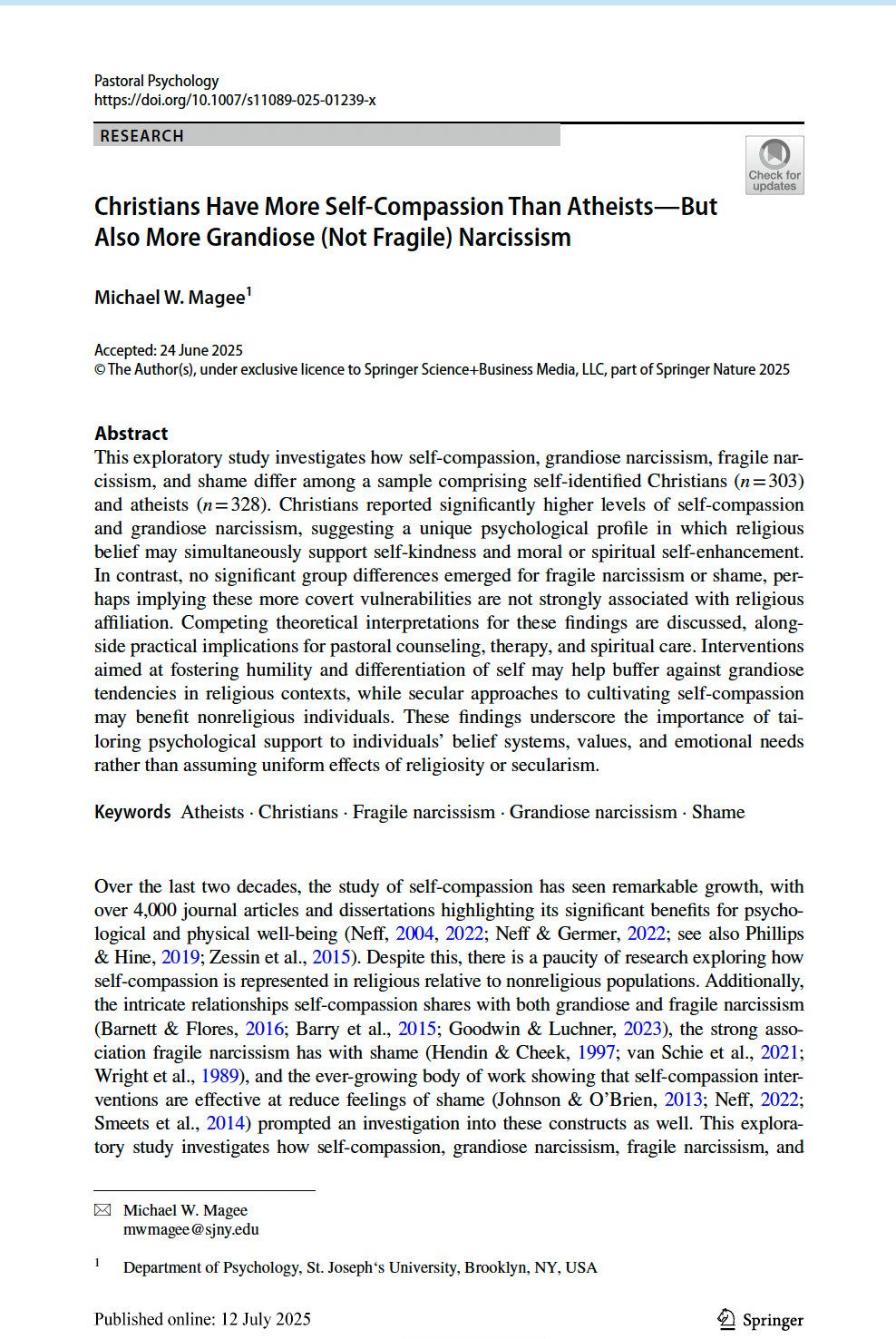
Christians Have More Self-Compassion Than Atheists—But Also More Grandiose (Not Fragile) Narcissism
Magee, M. W. (2025). Pastoral Psychology. https://doi.org/10.1007/s11089-025-01239-x
Schematic — direction of effects, not to scale. In plain EnglishReligious people were kinder to themselves than atheists were—and also thought more highly of themselves. The two went together, not against each other. The more hidden, fragile forms of insecurity looked the same in both groups.
Study summary
A large-sample comparison of self-identified Christians and atheists on self-compassion and two faces of narcissism. Christians scored higher on both self-compassion and grandiose narcissism, with no group difference on fragile narcissism or shame.
-
2023
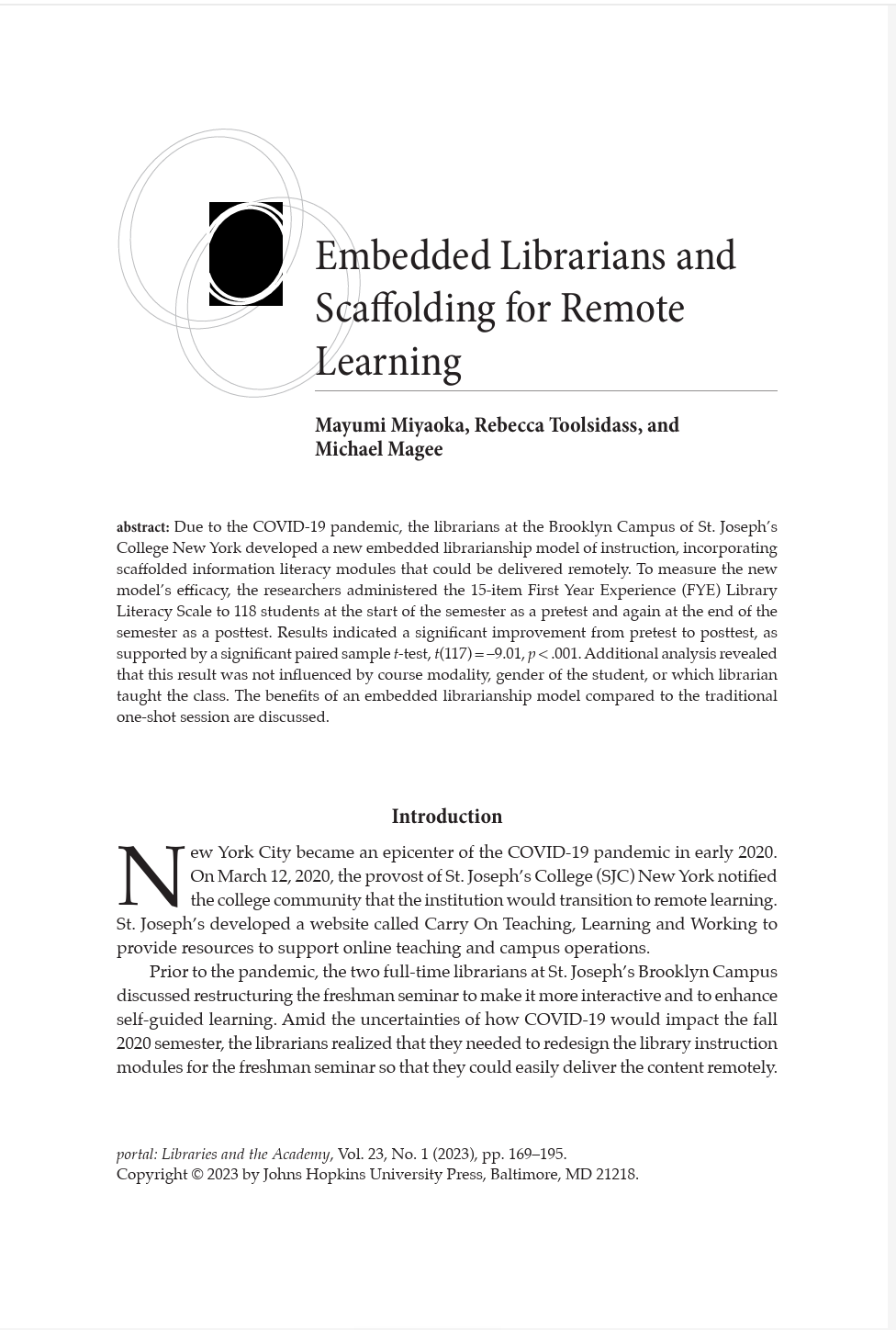
Embedded librarians and scaffolding for remote learning.
Miyaoka, M., Toolsidass, R., & Magee, M. (2023). portal: Libraries and the Academy, 23(1), 169–195. https://doi.org/10.1353/pla.2023.0010
Schematic — direction of effects, not to scale. In plain EnglishPut a librarian inside the course rather than across campus, and first-year students' library skills climbed over the semester—whether the class met online or in person, and whoever taught it.
Study summary
Pretest–posttest evaluation of an embedded-librarian model SJNY Brooklyn rolled out during COVID-19. The 15-item FYE Library Literacy Scale rose significantly across the semester (N = 118), independent of course modality, gender, or instructor.
-
2021
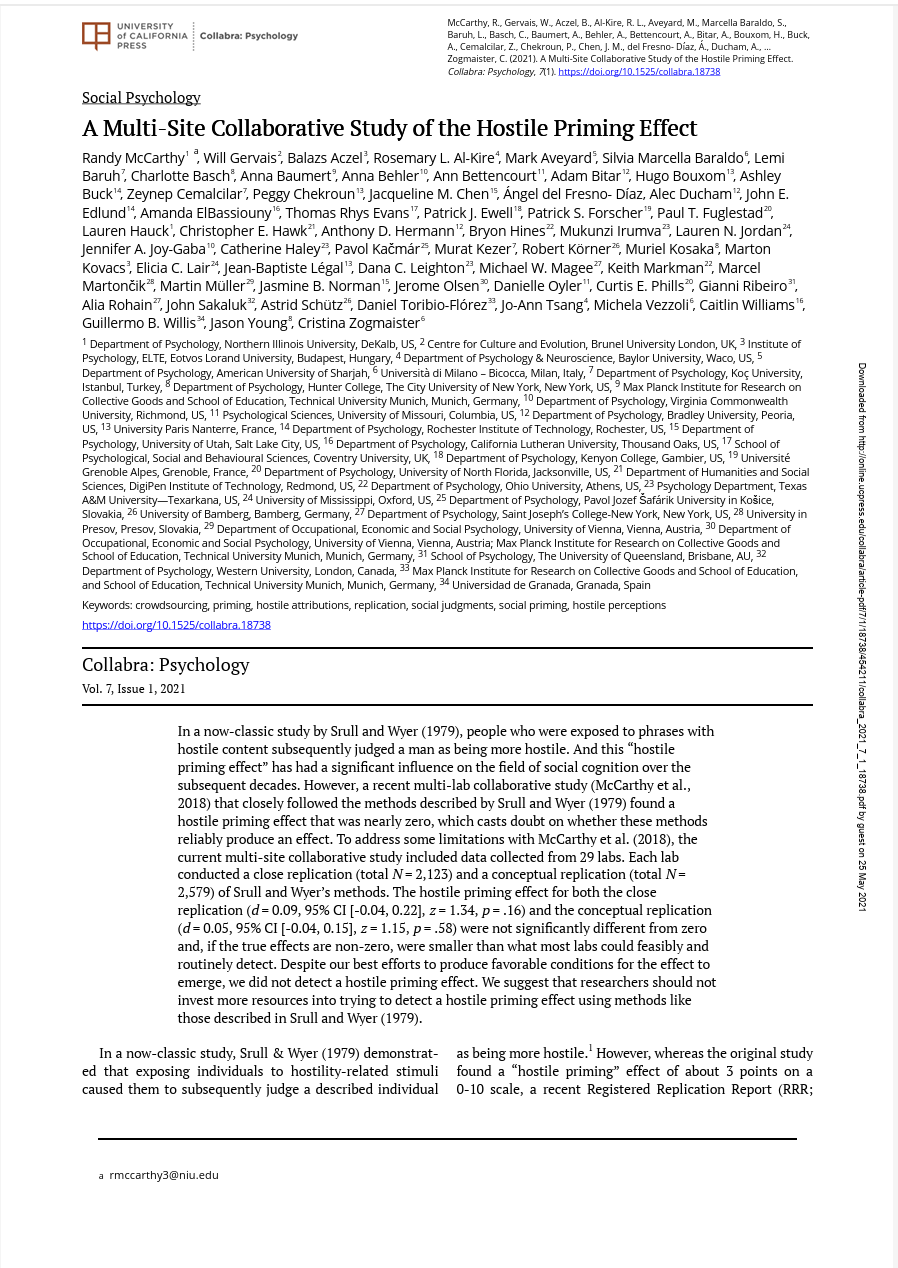
A multi-site collaborative study of the hostile priming effect.
McCarthy, R., … Magee, M. W., … (2021). Collabra: Psychology, 7(1), 18738. https://doi.org/10.1525/collabra.18738
Schematic — direction of effects, not to scale. In plain EnglishTwenty-nine labs tried to reproduce a famous 1979 result: that reading hostile words makes you judge a stranger as hostile. Across 4,700 people, the effect was indistinguishable from zero.
Study summary
A pre-registered, 54-author, multi-site replication of the Srull & Wyer (1979) hostile priming effect. One of the largest and most rigorously methodological tests of the effect to date.
-
2012
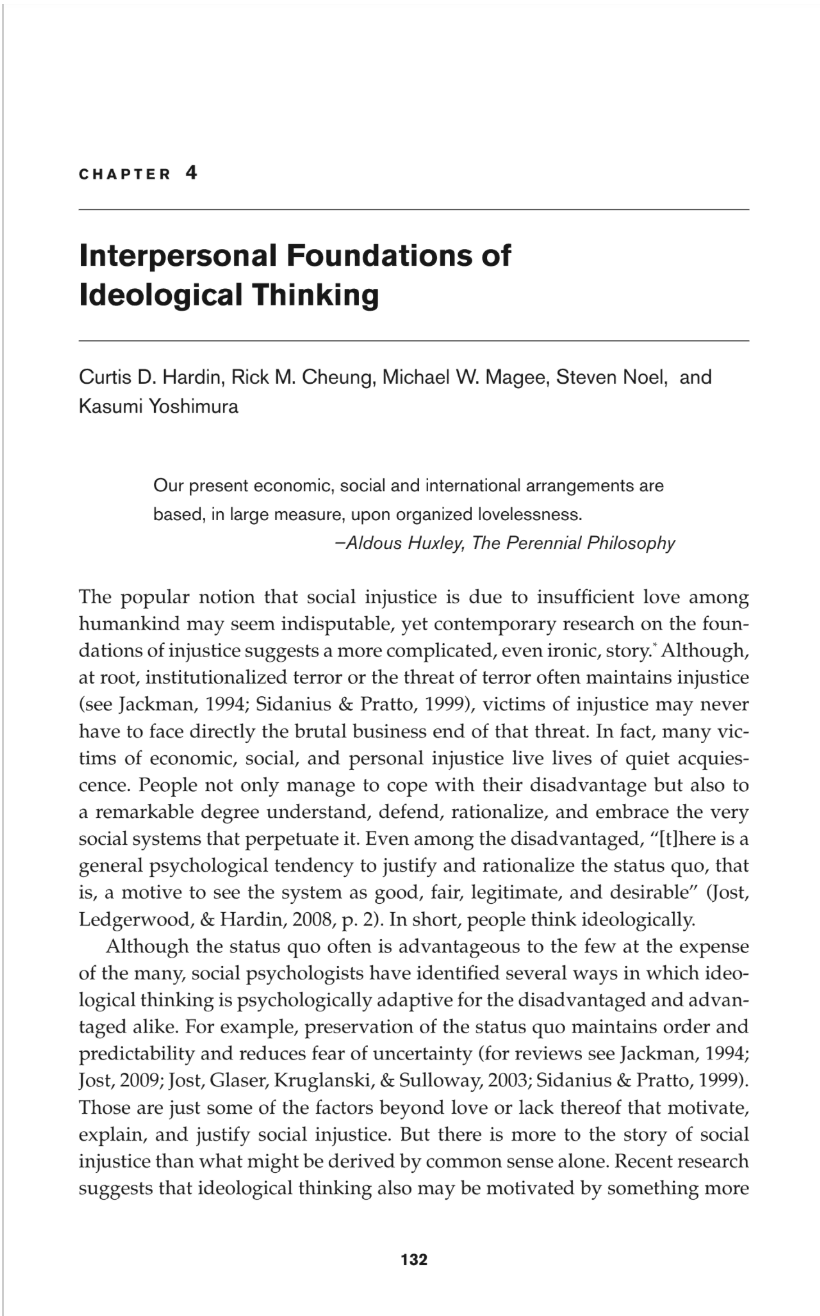
Interpersonal foundations of ideological thinking.
Hardin, C. D., Cheung, R. M., Magee, M. W., Noel, S., & Yoshimura, K. (2012). In J. Hanson (Ed.), Ideology, psychology, and law. Oxford University Press.
Schematic — direction of effects, not to scale. In plain EnglishIdeology feels like a private conviction. This chapter argues it is mostly a relationship: beliefs harden into ideology when they are shared with people who matter to us, and soften when that sharing breaks.
Study summary
A theoretical chapter applying shared-reality theory to the interpersonal grounding of ideology. Argues that what looks like fixed ideological commitment is partly the product of the social relationships in which beliefs are shared and reaffirmed.
-
2010
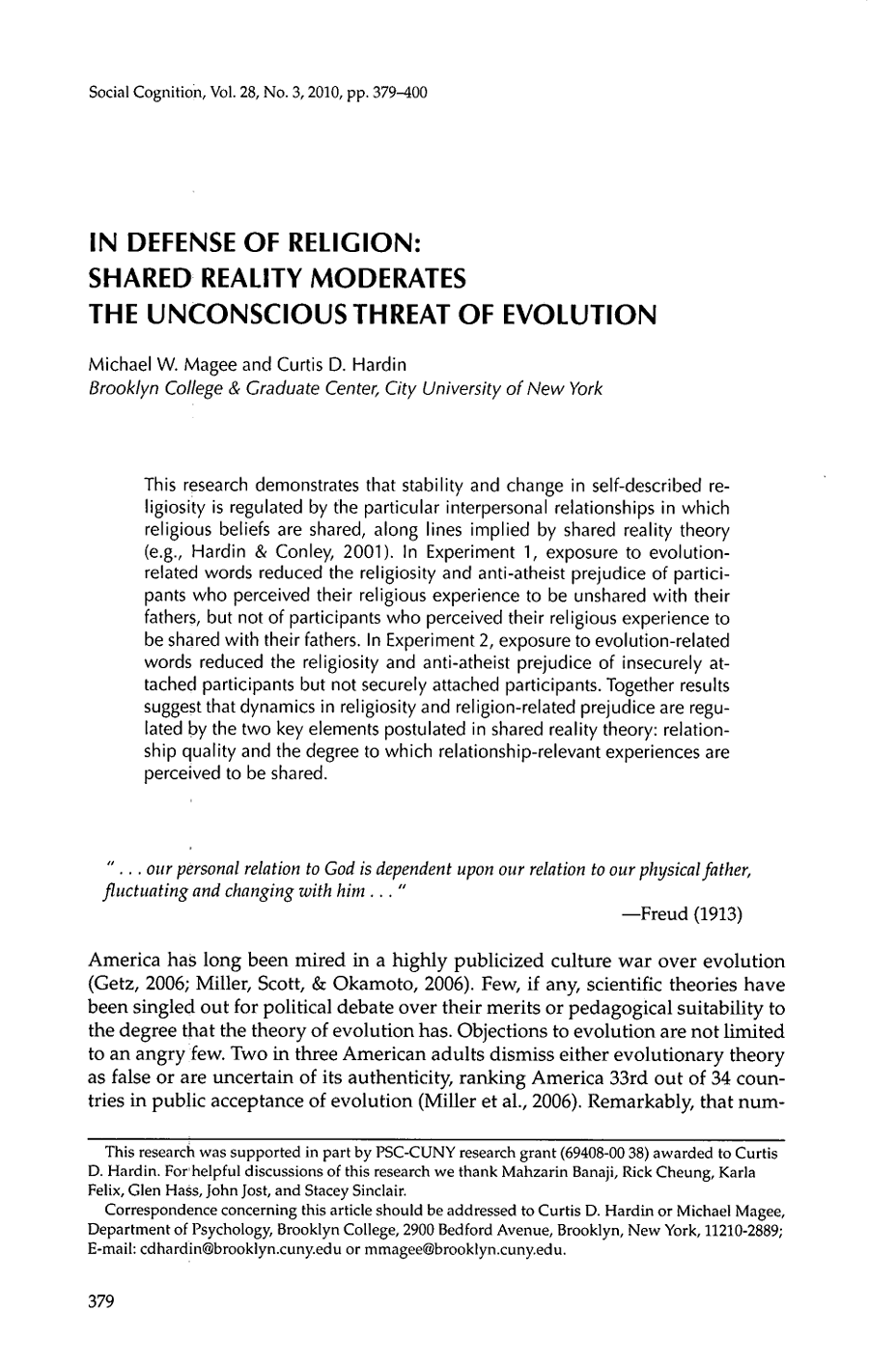
In defense of religion: Shared reality moderates the unconscious threat of evolution.
Magee, M. W., & Hardin, C. D. (2010). Social Cognition, 28(3), 379–400.
Schematic — direction of effects, not to scale. In plain EnglishA subtle reminder of evolution nudged people away from religion—but only if their faith was not shared with their father, or if they were insecurely attached. Shared belief acted as a shield.
Study summary
Two experiments showing that exposure to evolution-related words reduced religiosity and anti-atheist prejudice—but only among participants whose religious experience felt unshared with their fathers (Study 1) or who were insecurely attached (Study 2). A shared-reality account of when religious belief is and isn't socially buffered.